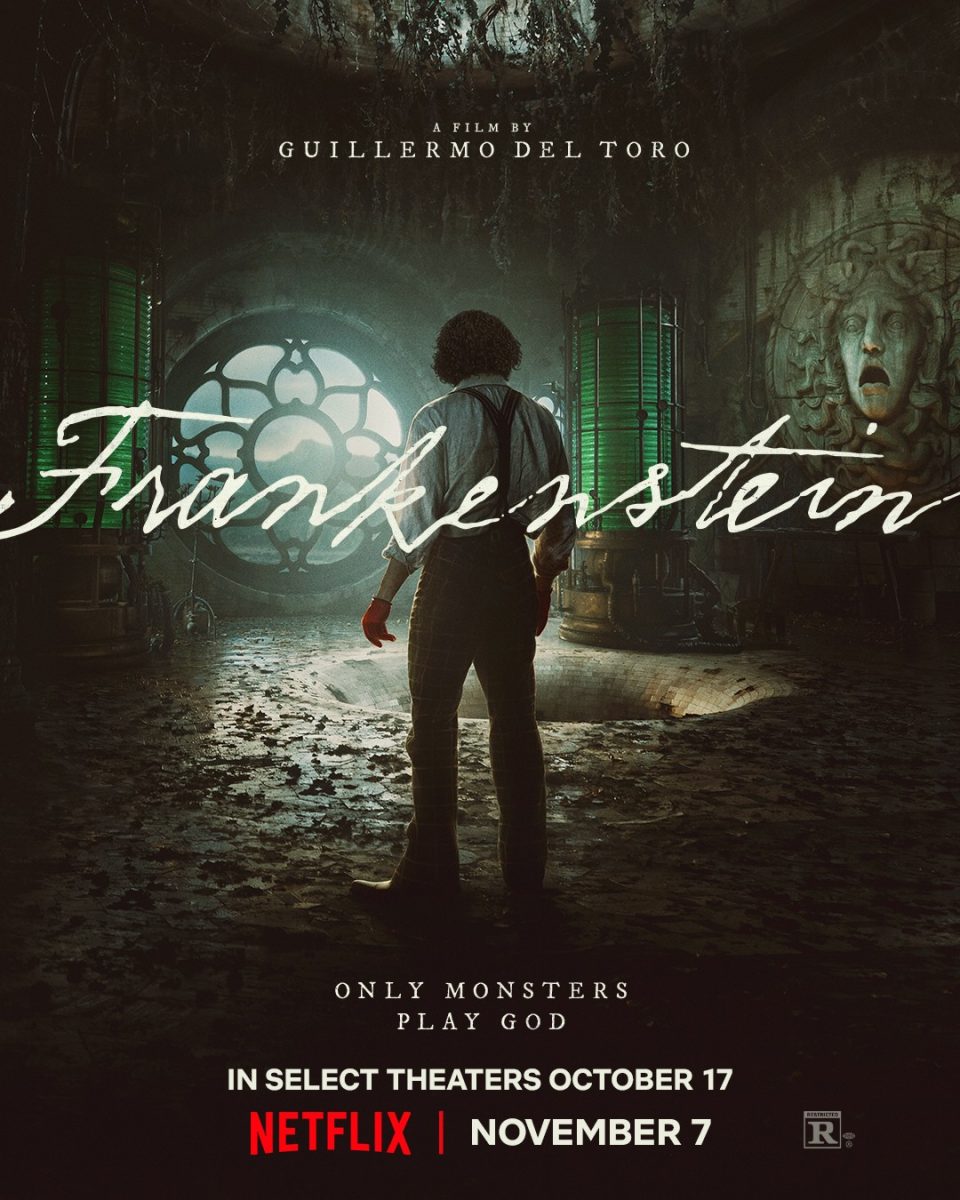
The age-old question: Is the book better than the movie? Nine times out of 10, the answer is a definitive “yes.” But this comes with the exception of certain movies such as Guillermo del Toro’s “Frankenstein.” I watched this two-and-a-half hour film the second it was released on Netflix, and from the first scene, I was utterly captivated for its entirety. I can confidently say that this is a cinematic masterpiece, even though it is nothing like the book.
The novel follows the story of Victor Frankenstein, who has a simple and (mostly) happy childhood and a desire to recreate human life, which stems from his misguided thirst for knowledge. Movie Victor, portrayed by Oscar Isaac, is physically abused by his father, and upon his mother’s death, decides to find a way to stop death altogether.
Elizabeth is a confusing character in both the movie and book depiction. For one thing, there are two versions of Mary Shelley’s “Frankenstein.” One was published in 1818, and the other in 1831. In the original, Elizabeth was Victor’s cousin. In the republication, she is an orphan adopted by his family and raised alongside him, with his mother hoping that the two will someday marry. My preference (for hopefully obvious reasons) is the second version. But the movie? It’s very different. Elizabeth is Victor’s brother’s fiancée. Yet, her romantic tension with Victor is present in both the book and the film. She’s also played by Mia Goth in the film, the same actress who plays Victor’s mother. It’s all a little Freudian, however you look at it.
Another difference is that Victor is much older in the film. In the novel, he is about 17 when he first discovers how to create life, which is roughly the same age as Shelley when she first wrote the novel. By the end of the book, Victor is in his late 20s. Isaac, meanwhile, is 46. This greatly changes the original image of a young, idealistic boy who lacks the knowledge to stray away from attempting the dangerous and ill-advised experiments. In del Toro’s depiction, Victor is a fully grown adult man and renowned surgeon. He should know better, shouldn’t he?
The Creature is, of course, the best part of both the book and the film. Shelley describes him as having “yellow skin” that “scarcely covered the work of muscles and arteries beneath” and “teeth of a pearly whiteness.” It took almost 10 hours for the costume designers to transform actor Jacob Elordi into the Creature. And the final product is perfect. It is the closest anyone has come, in my opinion, to the original image Shelley created. Elordi’s Creature is no green-painted, bolts-in-the-skull mindless monster. It is wonderfully human, as beautiful and terrifying as the original.
But the question remains: Is it better than the original? Not really. It’s just different. They are both beautiful. “Frankenstein” is about men who play God and suffer for the consequences of their actions. But more than that, it’s about humanity. What makes someone human? The Creature, with his desperate attempts to connect with others, his desire for companionship and his ultimate need for vengeance after being abandoned and abused, is incredibly human. In some ways, he might be more human than Victor, who prioritizes science over forming connections.
“Frankenstein” is a great book to read at night with a cup of tea and rain in the background. (I speak from personal experience.) I recommend watching the movie with family. Both are wonderful, even if they are so different, they might as well be two different works. The movie bears very little resemblance to Shelley’s original, but I actually think del Toro might just be crafting a new method of book adaptations: not a frame-by-frame recreation, but taking the original and reimagining it. Regardless, I love both the book and the film. Fair warning, I also cried at both. Enjoy them.