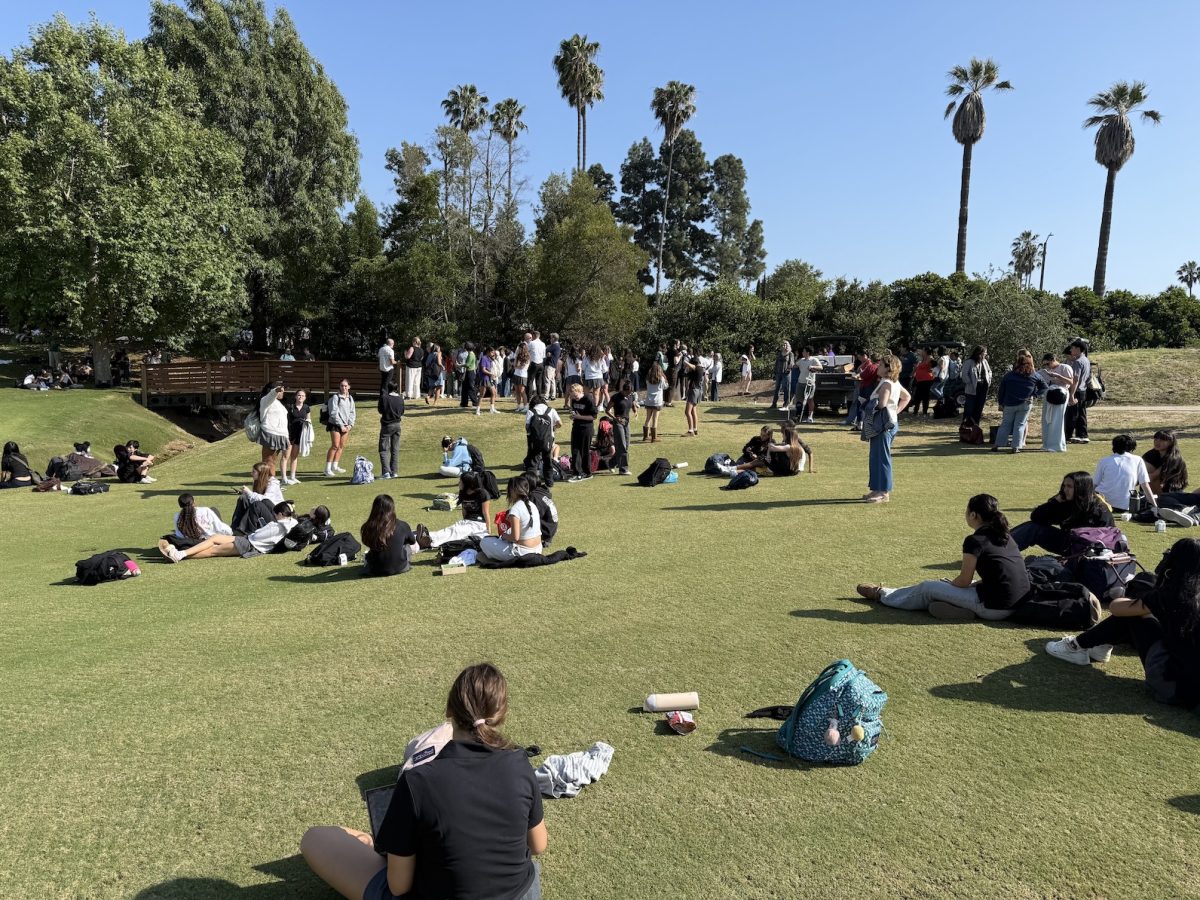
On May 8 at 1:12 p.m., Marlborough students, faculty and staff were warned to shelter in place through emails and texts after the School received a threatening phone call. F period classes were canceled shortly after, though teachers continued to teach their I period classes, leading to an extended period. Then, at around 3:42 p.m., students were evacuated through the Rossmore entrance and directed across the street to wait at the Wilshire Country Club while police investigated a suspicious package on Arden Boulevard close to campus.
Hours later, students learned the threat was a hoax and part of what authorities believe was a larger swatting incident affecting multiple schools across Los Angeles that day.
Swatting refers to false emergency calls that are intended to trigger a major police response, including SWAT teams. In recent years, these incidents have been increasingly common across Southern California, targeting schools, hospitals, celebrities and public institutions. According to ABC7, law enforcement saw an increase in swatting cases, where many required large-scale emergency responses despite turning out to be hoaxes.
Although these threats may be fake, the disruption they cause is very real. Beyond the initial fear and confusion these threats may cause, swatting incidents place enormous financial strain on schools and emergency services. A report from Campus Safety Magazine found that each swatting incident at a school costs at least $100,000 in emergency response expenses, including but not limited to SWAT deployment, outside agency assistance and hours spent searching through campuses. On a nationwide scale, false threats cost an estimated $82.3 million in 2023, according to researcher David Riedman, which doesn’t account for the larger impact on students and parents.
“The real cost that includes missed class time, missed work time for parents and physical damage (e.g., breaking doors, police cars crashing on the way to the school, insurance settlements for injuries) is easily in the hundreds of millions,” Riedman wrote in a Substack post.
With the shelter-in-place warning taking place during AP testing, AP Chinese students, whose exams were scheduled during the threat, were interrupted by the incident.
“They made sure not to stress us out; we knew that there was a semi-lockdown, but we didn’t know that we needed to evacuate until we needed to exit the test, which alleviated our stress,” Anamika ’27 said.
For many students, the uncertainty of the situation was the hardest part. With limited information available throughout the afternoon, rumors spread rapidly.
Though the threat ultimately proved to be false after the Los Angeles Police Department determined that the suspicious package was benign, the incident showed how seriously schools and law enforcement take every report.
“Moments like this are stressful and disruptive, to say the least, and your composure and cooperation made a real difference,” Head of School Jennifer Ciccarelli said in an All-School email addressing the situation.