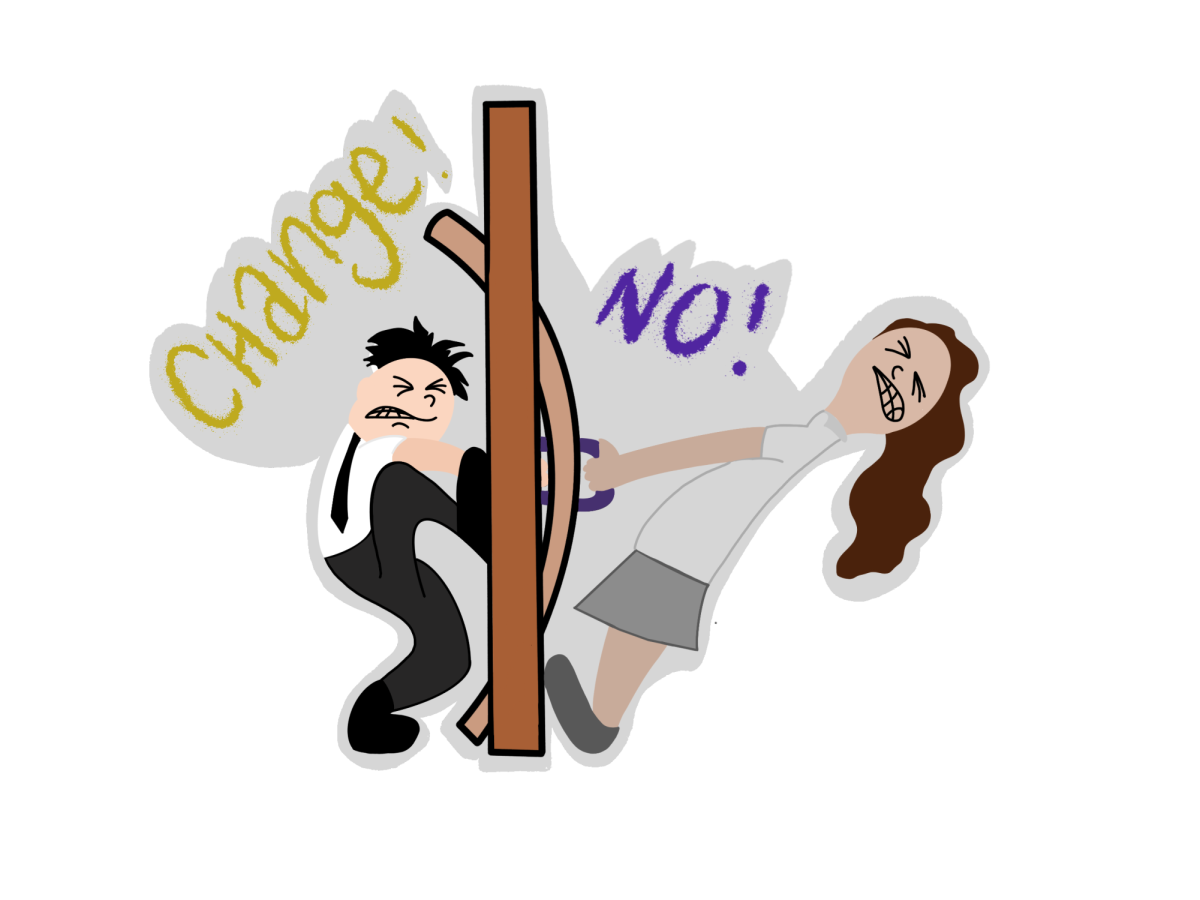
According to the Archbridge Institute, 69% of Americans believe they either have or are on their way to achieving the American dream. According to the Oxford English Dictionary, the American dream is “the ideal that every citizen of the United States should have an equal opportunity to achieve success and prosperity through hard work, determination, and initiative.” In 1931, the term was officially coined by historian and writer James Truslow Adams in his book “The Epic of America.” Adams characterized the term as a vision of commonwealth and mutual social order in which each man and woman is recognized for the “fullest stature of which they are innately capable.”
“The original definition of the American Dream by James Truslow Adams refers to the dream being about seeking to find a richer, better and fuller life regardless of where you started. So richer plays a part of that equation,” said Gonzalo Schwarz, the president and CEO at the Archbridge Institute on the Archbridge Institute website.
Even before this, books like “The Great Gatsby” by F. Scott Fitzgerald, which was published in 1925, allude to the rudimentary ideals of the American dream. Fitzgerald viewed the idea as unattainable and endangering, evidenced by the plotline that follows the protagonists’ deaths in search of achieving this dream. “The Great Gatsby” continues to be taught nationally in classrooms, with over 500,000 copies sold per year.
Following Adams’ official definition, the term became embedded in American vocabulary and actively portrayed in media, including literature, television, political strategies and advertisements. One example of the American dream’s incorporation into the media was in 1963 when Martin Luther King Jr. delivered his “I Have a Dream” speech to 250,000 people at the March on Washington for Jobs and Freedom, one of the largest political rallies in American history. He claimed his speech was “deeply rooted in the American dream” as he challenged racial inequality and segregation. On YouTube, a recording of the speech has over 28 million views and is now built into the Common Core State Standards, a set of academic criteria for K-12 educational curricula that has been adopted nationwide.
In the 21st century, the term often idolizes the “self-made man” and dramatizes the unparalleled opportunities the United States presents for Americans. Oftentimes, the term is also associated with immigrants’ desires to enter the U.S.
Television hits that highlight real people such as “Shark Tank,” “America’s Got Talent” and “American Idol” personify the American dream as everyday contestants win cash prizes, large investments or even a residency in Las Vegas. Additionally, fictional television shows and movies like “The Pursuit of Happyness” and “Forrest Gump” portray protagonists who go from the brink of poverty to being a billionaire, war hero and sports star. On TikTok, there are over 250,000 videos and 1.8 million posts on Instagram with the hashtag #americandream. On both social media outlets, the idea of the American dream is manipulated on both sides of the spectrum: As something all U.S. inhabitants should work towards and also something that is unrealistic and unattainable.
“When I come across media content on this topic, it’s almost always pessimistic. Many declare that the American dream is dead, out of reach or a complete lie,” Schwarz said on the Archbridge Institute website.
“American” is the noun form of “America,” and to be “American” is often defined as a resident of the U.S., something tied to geography. But, for many students growing up outside the U.S., “America” is more than a place on the map, but rather something more, imagined through media, education and personal experience.
At the center of these ideas is the American dream. This dream has long defined how America has been perceived by the rest of the world and while this idea still holds power, its meaning becomes less certain and begins to differ among different students. For some students, this meaning begins with freedom.
“In my perception, the American dream means freedom,” said Ava Choi, a freshman at Yongsan International School of Seoul (YISS). “It represents the ability to express myself, make my own decisions and pursue a life that I want without any limitations.”
Choi, who was born in Santa Monica and moved to Seoul at the age of six, described how her understanding of the U.S. is shaped largely through the media. From TikTok to movies, she sees the portrayals of American school life, friendships, lifestyles and fashion, but said that these images are often “more glamorous and idealized than they actually are.”
Other students define the dream more in terms of opportunity but question whether that opportunity is truly equal. Kayla Choi ’29, another freshman at YISS, said that the American dream is built on access.
“To me, the American dream means that everyone has an equal opportunity to succeed, regardless of ethnicity or race,” Kayla Choi said.
Kayla Choi explained that her American-based education while studying at an international school keeps her connected to values like individualism and equality, even while she is physically outside of the U.S. However, this connection has made her more aware of the American dream’s limits.
“From my perspective, the American dream no longer fully exists because opportunities are not equally accessible to everyone,” Kayla Choi said.
This tension of the difference in belief and reality appears to hold strong across borders. Luca Figueres ’27, a junior who was born in Chicago but now attends a local public high school in Spain, described the American dream as individualistic.
“For me, the American dream is freedom, in all senses of the word, being able to fend for yourself and relying only on yourself,” Figueres said. But freedom, he said, is often misunderstood. “Freedom also means that no one is responsible for you other than yourself; the goal is not fancy cars and big houses, it is being able to fend for yourself in sometimes unforgiving reality,” Figueres said.
The American dream is defined differently depending on perspective, but so is the way the U.S. itself is viewed. In Kazakhstan, Dilyara Malgeldinova, a junior at QSI International School of Astana, described that this perception shifts depending on who you ask, especially as it is heavily shaped by the media.
“The political landscape of America is definitely chaotic, but people my age [see it as] the dream place,” Malgeldinova said.
Despite acknowledging that media highlights the “bad side” and dramatizes reality, she still described the U.S. as a place she envisions her future, somewhere she would like to live as being there makes her feel free.
This sense of aspiration, even when it is alongside criticism, is echoed by students who have experienced or are preparing to experience life in the U.S. more directly. Hyungsu Kang, a 2025 high school graduate now studying at Cornell after being raised in Vietnam, described the American dream in practical terms.
“[The American dream is] an idea which makes me believe I can financially be successful in the U.S.” Kang said.
For Kang, the appeal of the U.S. lies in opportunities, especially economic opportunities, but also its values.
“Yes. America is where people’s values are most acknowledged and is a place with the highest salaries,” Kang said when asked if the American Dream still exists.
At the same time, he said that with his experience, once entering a new environment, there comes an uncomfortable adjustment. Kang said that he feels “most American” when he can speak in the same manner and pronunciation, but most distant when learning new cultures and concepts. He explained that even with his years in the U.S., he experiences an ongoing process of assimilation.
Esther Kim ’25, a resident of South Korea, said her perception has been shaped by both literature and history, and that the American dream seems more like a superficial concept that isn’t realistic.
Still, she acknowledged that the American dream influence continues to persist, and even as she sees it as idealistic, she noted that even unconsciously, the idea of success in the U.S. has somehow been inserted to her, which shows how deeply this concept has spread.
For students who live both inside and outside the U.S., the dream becomes more nuanced. Kaz Kousaka ’27, a junior at Choate Rosemary Hall who grew up in Singapore, said his perspective shifted after experiencing American life firsthand.
“The opportunities I get here aren’t accessible to a lot of other people,” Kousaka said. Even so, he does not reject the idea entirely; he just disbelieves that the American Dream applies to everyone equally.
Across these perspectives, it is evident that the American dream does not collapse, but instead stretches to change slightly in definition. As experiences collect, the American dream shifts to represent different narratives. The nuance extends even to the symbols associated with the country. When asked about the American flag, students’ responses showed the same mix of connection (and distance) that shaped their views of the American Dream itself.
“When I think of the American flag, freedom and identity comes to mind,” Ava Choi said. “When I encounter an American flag, I feel proud of my nationality.”
For others, the meaning of the flag is less personal.
“The American flag makes me think about the conflicts and inequalities within the states,” Kousaka said. “[The flag] is more a representation of the idea of America, and more just symbolic.”
When asked about how the American dream has evolved and the way people have identified themselves with it, Marlborough History Instructor Katherine Pollock responded that “the idea of the American dream, whether that is reality, is up for debate.” Regarding how attainable the American dream is, Pollock believes that its economic aspect has become less possible as the prices of undergraduate education and health care continue to become more expensive. She says that recently there has been more of “a widespread societal acceptance or belief that maybe the American dream was not actually the American dream you thought it was.” To Pollock, the “idea of the American dream functions as a pacifier, the promise that no matter what situation you’re born into, your life can improve just by virtue of America” and that the select few who do amass a huge amount of wealth despite not growing up with it do not accurately represent a system-wide reality.
Pollock believes that the American flag is “more associated with perhaps the darker side of this country” referring to how “this country was built on the backs of enslaved people that was only built after a genocide of indigenous people.” To her, there is “a many centuries long-broken promise to the descendants of enslaved people in this country who are owed reparations from the country that has still not been carried out. For a lot of marginalized groups, the flag can and does represent something quite violent and ugly about American history,” Pollock said. “For a lot of people in the world, the American flag is both a promise and symbol of the destruction that the U.S. has brought to the world.”
In a schoolwide survey about the American dream, there was a common trend in which many students acknowledged the American dream’s unattainability and its treatment toward marginalized groups.
“You can’t promote America as a great full of opportunity and freedom, and then force people out when they come. I also think the attainability of the American dream depends on the person’s identity and whether they are part of the majority or a minority,” said Natalie Rosen ’28.
Shami Nyarwaya ’30 learned about the American dream in 5th grade when she read the novel “Front Desk,” which follows the protagonist, Mia, whose Asian immigrant parents struggled to make ends meet.
“America is considered ‘the land of the free,’ but that doesn’t make sense because America oversaw one of the worst cases of enslavement in history. It is the land of opportunities and while I believe in America there are many privileges. Your access to these opportunities is greatly influenced by your identity. It’s misleading. You can praise a country without completely disregarding its faults,“ Nyarwaya said.
“Millions of people have achieved it through vastly different ways, whether it is through hard work, corruption, or just luck. But, I recognize that it is very difficult to achieve, and the inequalities in our society make it incredibly hard for many people to achieve.” Phoebe Okin-Kelleher ’30 said.
“It’s not unattainable, it’s just an idea that we all get all these good things that we never do. The ‘American dream’ is just an idea that makes people think we are the greatest,” Mila Lanin ’30 said.
However, the American flag is extremely multivalent. Nyarwaya recognizes that as a child of immigrants, she has some distaste for the American flag with what she knows about her history.
“I just wish our history was kinder. To me, the flag symbolizes diversity and unity as well as rewritten history and silenced voices. The flag carries a weight that I’ll never fully understand,” Nyarwaya said.
On the other hand, the American flag holds a positive meaning to others.
“The American flag holds a positive value to me because it represents the unity and significance of each state while recognizing the first states. It also is a way to say that unity still strives during struggles with justice as well as disagreements in the world,” Tabitha Johnson ’29 said.
The American Dream and flag is meaningful to many people, many different things to many different people all at once, whether that meaning is positive or negative.