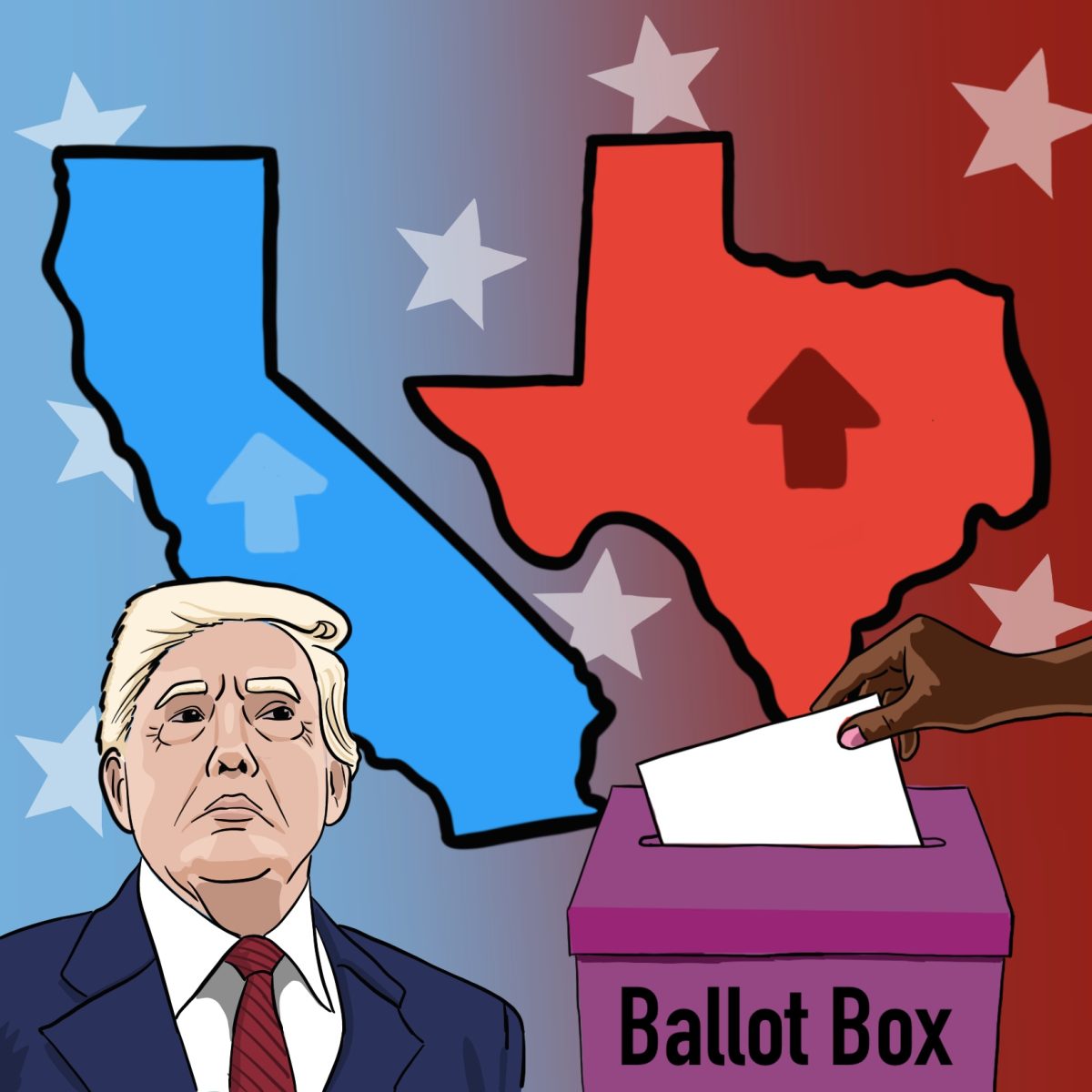
President Donald Trump’s second term has been marked by a resurgence of aggressive U.S. expansionism. The U.S. government has engaged, or articulated plans to engage, internationally throughout the first year of Trump’s second term. This attitude deviates from his opposition and criticism to foreign military conflict in his first term.
United States expansionist policy is rooted in 19th century history. The Monroe Doctrine was issued in 1823 amid a period of independence by Latin and South American nations from European powers. This doctrine aimed to end European interference in the Western Hemisphere, and it would later grow to symbolize the United States’ military dominance in the region. History Instructor Dan Lynch commented on the initial efficacy of the Monroe Doctrine in resisting European intervention, while also setting a precedent for U.S. dominance of the region.
“The Monroe Doctrine was initially toothless and the U.S. had no ability to enforce it, as the U.S. was a New Republic, and it was really starting out as a nation,” Lynch said. “Then the U.S. got more powerful through western expansion, through the Mexican American War and through the Civil War, and that’s when you see the U.S. really start to exert its influence in the Western Hemisphere.”
The Monroe Doctrine has become a guiding principle in various instances of U.S. history since it was issued. Notably, in 1904, President Theodore Roosevelt issued a corollary statement to the Monroe Doctrine to justify his administration’s intervention in various Latin American nations. He explained how in instances of wrongdoing, international police power is needed.
Since this instance in 1904, Roosevelt’s corollary statement and the Monroe Doctrine have supported the United States’ partial orchestration of military coups in Guatemala and Chile in the late 20th Century, the United States’ failed “Bay of Pigs” invasion of Cuba in 1961, the invasion of Panama in 1989 and many other cases.
Trump adopted the philosophy of the Monroe Doctrine by issuing a corollary to the Monroe Doctrine on Dec. 5, 2025, which he called the “Donroe Doctrine.” This statement aimed to reinforce the United States’ military control over the Western Hemisphere, resisting nations such as China and giving Trump influence over affairs in the hemisphere. Ruby ’26 commented on the way she has seen the Donroe Doctrine play out in U.S. foreign policy.
“The Donroe Doctrine reflects a long-standing American tradition of American moral exceptionalism in which nationalist rhetoric and ‘American values’ of freedom are broadcasted at home while policy that directly contradicts those values is enacted abroad,” Ruby said.
This attitude was reflected in the early days of Trump’s second term through his offers to buy or annex the island of Greenland, which has been met with resistance. Additionally, Trump renamed the Gulf of Mexico to the Gulf of America on Jan. 25, 2025, to similarly assert U.S. dominance in the region. Trump’s claims to the Panama Canal and indications of future involvement in Colombia and Cuba also demonstrate these ideals.
The most notable reflection of the Donroe Doctrine was Trump’s capture of Venezuelan President Nicolás Maduro and his wife on Jan. 3, 2026. The action violated international law by going against Article 2(4) of the United Nations Charter, which protects political independence by prohibiting the use of violence from one member state to another. Trump’s actions against the Venezuelan government directly violate this international law. This has since placed Venezuela in jeopardy and caused harsh criticism of Trump’s foreign policy. Lynch commented on Trump’s abduction of Maduro and what he thinks it means for the future of U.S. policy.
“Trump is engaging in, in some ways, more robust interventionism than previous presidents, as seen by the abduction of Maduro and by and seen by the threats of invasion of Greenland,” Lynch said. “But as for the future, the U.S. policy, it seems as if Trump is going in the direction of asserting greater control in the Western Hemisphere.”