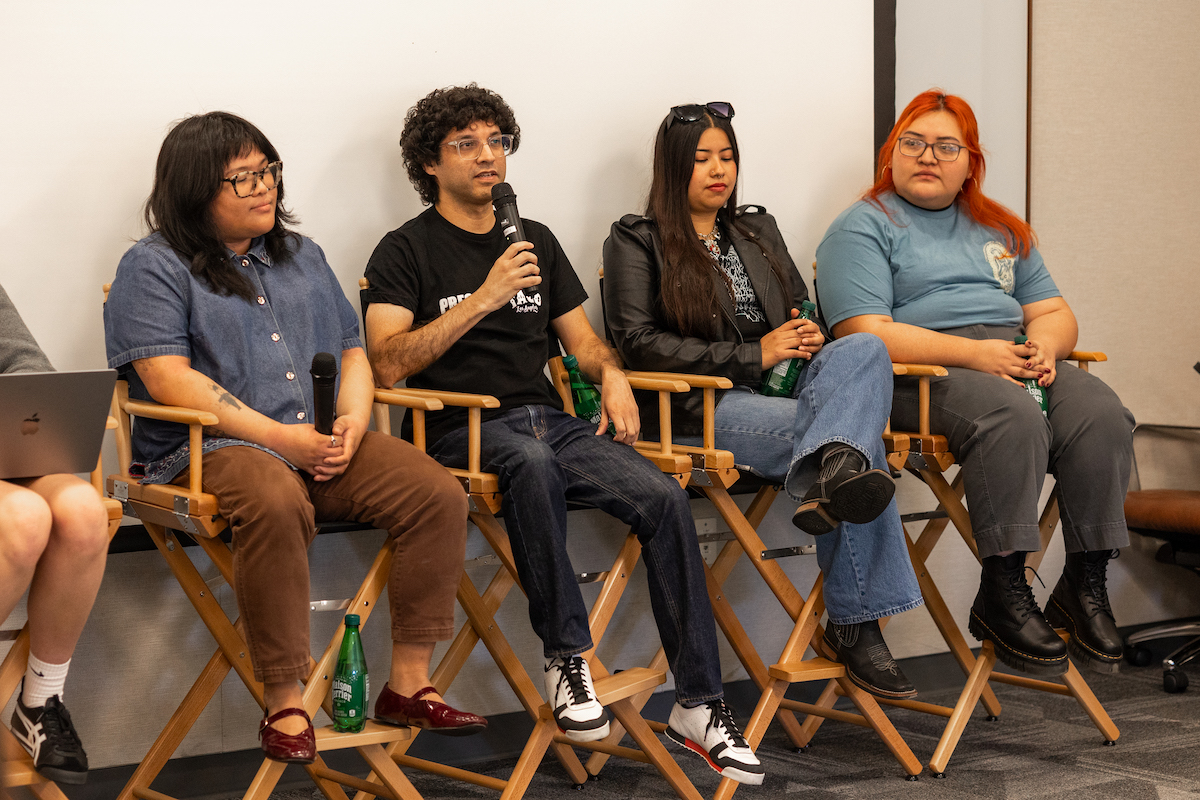
On Dec. 12, Marlborough hosted a Pushing Perspectives with four journalists from LA TACO, an independently owned Los Angeles-based media outlet known for its grassroots and community-centered reporting. The discussion, which was organized by Dean of Social Justice and Community Partnerships Pamela Wright and facilitated by UltraViolet Co-Managing Editor Paloma ’26, focused on media literacy, the evolving role of journalism and how local reports document stories that are often overlooked by mainstream news outlets.
Founded in 2006, LA TACO began as a blog, covering underground culture, street food and taquerias across LA. Over the years, its mission expanded as reporters recognized that writing about street vendors meant confronting the policies, laws and injustices that directly affected the vendors. This shift in perspective led LA TACO to cover issues such as the U.S. Immigration and Customs Enforcement (ICE) raids, which now define most of LA TACO’s reporting.
Rather than prioritizing breaking statistics or one-day headlines, LA TACO emphasizes people-centered journalism, focusing on how large-scale events affect individuals long after mainstream attention has moved forward. The outlet’s reporters emphasized that their goal is not just to inform, but also to remain accountable to the communities that they cover and interview.
“Bigger news stations focus on the numbers and major events, but we want to focus on the people,” LA TACO writer and editorial assistant Julianne Le said. “We revisit those stories later on, to ask them about their lives and their updates.”
One of the clearest examples of this approach is LA TACO’s use of social media as a tool for reporting. LA TACO uses social media platforms as an immediate and credible source, particularly through its Daily Memo by Memo Torres, which documents where ICE raids are occurring in real time. Originally launched as a newsletter, the Daily Memo now serves as a resource for communities far beyond street vendors.
As immigration enforcement intensified, LA TACO hired more reporters to help Torres with gathering information for the daily post. The emotional toll of this work has become increasingly visible. Aisha Wallace-Palomares, a multimedia reporter and member of the Daily Memo team, described the challenges of verifying stories that often capture people in their most vulnerable states.
“The first month was really overwhelming because it was a lot of work,” Wallace-Palomares said. “You’re basically looking at people’s most traumatic moment of their lives, and I just need to screen-record it to verify.”
Despite the challenges, Wallace-Palomares sees the work as essential. “In times like these, where people are scared to speak up, I want to document and write in order to inform others that this is real and that this is happening,” she said.
She also credited LA TACO for allowing its reporters freedom and trust to report the information they value and liberty when choosing the angle they wanted to write stories on.
During the Pushing Perspectives, Ivan Fernandez, a weekend editor for LA TACO, spoke about the range of stories he has covered. From local politics to LA culture, his experience reflects LA TACO’s fluid approach to journalism.
For social media producer Alejandra Cid, that responsibility extends to how stories are shared online. Cid, who joined LA TACO full-time in October 2025, discussed the challenge of balancing accuracy with engagement in a fast-paced digital environment.
“It’s important to get that balance of capturing people’s attention and getting the story out,” Cid said.
Throughout the Pushing Perspectives event, the journalists distinguished between traditional reporting and community-based journalism. Rather than observing from a distance, LA TACO reports act as a resource for the communities they serve by documenting injustices, verifying information and amplifying voices that might otherwise go unheard.
“I don’t even care if a person doesn’t read all the way through,” Le said. “I’m just grateful for people to take a look and do something in a world where we often feel so powerless.”